

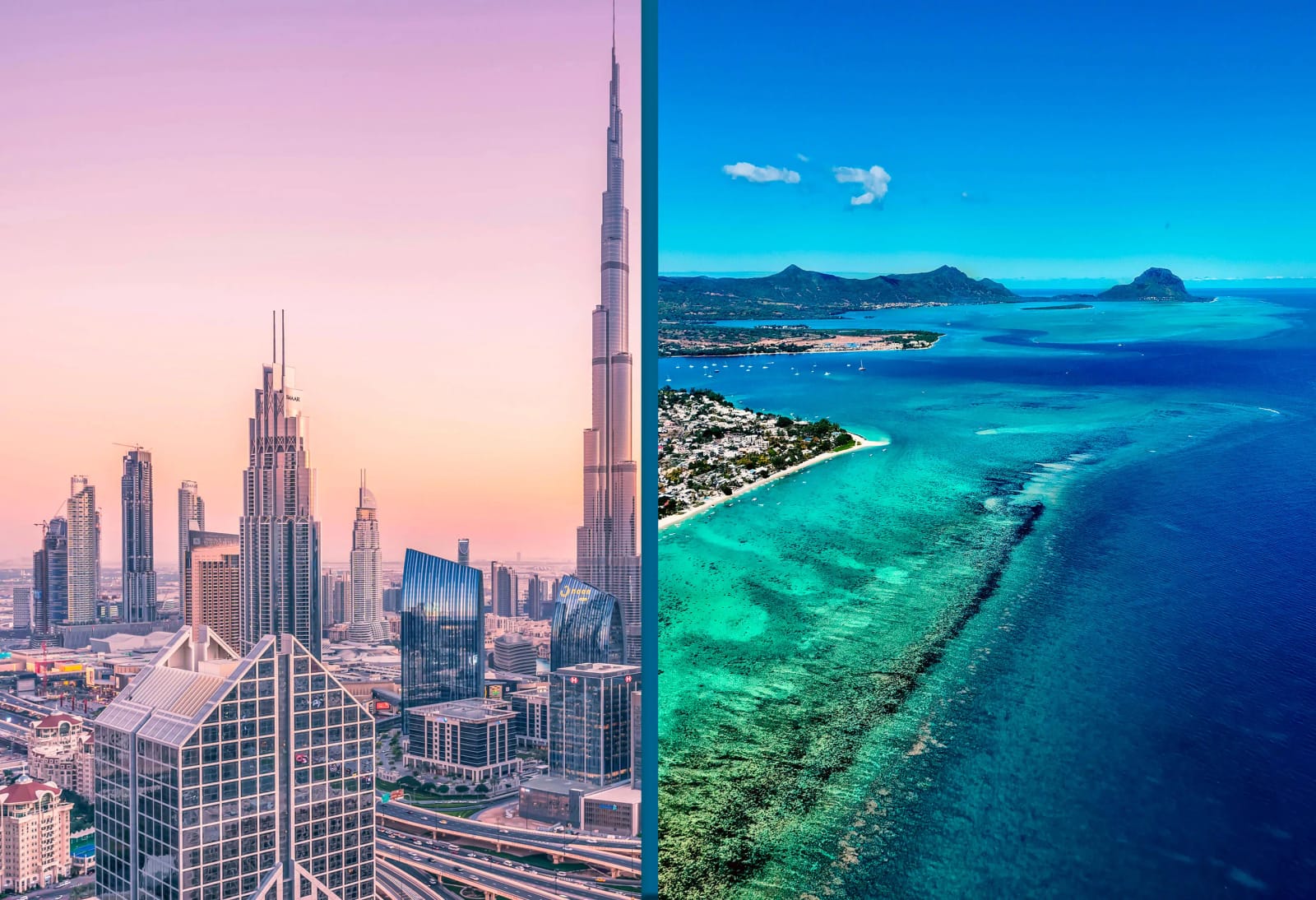
Dubai and Mauritius both attract expats, but for opposite reasons. Short answer: Dubai to maximise a salary, Mauritius to build a life. The world-city offers 0% income tax and fast-track careers; the island offers a reasonable cost of living, full freehold property ownership and a permanent residence permit from a USD 375,000 purchase. The details, point by point.
The comparison at a glance
| Criteria | Dubai | Mauritius |
|---|---|---|
| Income tax | 0% | 0 to 20% maximum |
| Cost of living | High | Moderate |
| Rent for a family home | Very high in prime areas | Reasonable, even in Grand Baie |
| Residency through property | 10-year golden visa, from around €510,000 | Permanent permit from USD 375,000 |
| Everyday language | English | English and French |
| Direct flight from Paris | 7h | 11h |
| Climate | Desert, summers above 40°C | Tropical all year round |
Cost of living: the gap widens fast
In Dubai, rents in prime areas (Downtown, Marina, Palm Jumeirah) run to thousands of euros per month for a one-bedroom apartment, and international schools cost several thousand euros per year per child. High salaries compensate, as long as the salary is there.
In Mauritius, the cost of living is markedly more affordable: reasonable rents even in expat areas such as Grand Baie or Tamarin, accessible restaurants and services, quality international schools at fees well below those of the Gulf. Our article on the cost of living in Mauritius breaks the budgets down line by line.
Property and residency: permanent versus renewable
In Dubai, property purchases are limited to designated freehold areas and the renewable 10-year golden visa requires an investment of around €510,000.
In Mauritius, buying in an approved scheme is full freehold, and USD 375,000 is enough for a permanent residence permit covering the whole family, valid as long as you own the property. The entry point is also more accessible: from €150,000 in an R+2 apartment.
Taxation: 0% versus 20% maximum, but everything counts
Dubai wins on the tax return: 0% on income. Mauritius answers with a scale capped at 20% (0% up to Rs 500,000 of annual income), zero property tax, zero wealth tax, zero capital gains tax, zero inheritance tax in the direct line, and a tax treaty with France. Once the cost of living is factored in, the equation often tilts towards the Indian Ocean: our full tax guide does the maths.
Daily life: the world-city versus the island
Dubai is hyper-modernity: giant malls, international events, an air hub to the whole world, and an intense professional pace. The flip side: summers above 40°C lived indoors in air conditioning, and a social life that revolves largely around work.
Mauritius is life outdoors all year round: lagoon, golf, hiking, accredited French schools, English- and French-speaking doctors, modern private clinics. Families settle for the long term, especially in the North and in the West. The time difference with Paris is only 2 to 3 hours: remote workers keep their European teams without living at night.
Our verdict by profile
- International career and salary to maximise: Dubai, for as long as the professional adventure lasts.
- A family settling down: Mauritius, for the schools, the languages and the stability.
- Wealth-focused investor: Mauritius, for accessible freehold, the permanent permit and zero holding taxes.
- Retiree: Mauritius, without hesitation: lifestyle, healthcare and a dedicated permit from age 50.
Frequently asked questions
Where do you pay less tax: Dubai or Mauritius?
On the tax return alone, Dubai wins with 0% income tax. But the full equation changes the picture: cost of living and property are far more expensive in Dubai, while Mauritius combines tax capped at 20% (0% up to Rs 500,000 of annual income), zero capital gains tax and zero inheritance tax in the direct line. The details are in our Mauritian tax guide.
Can you get permanent residency in Dubai through property?
Dubai offers a renewable 10-year golden visa from around €510,000 of property purchase. In Mauritius, a USD 375,000 purchase in an approved scheme gives a permanent residence permit, valid as long as you own the property, for the whole family.
Which destination for a family?
Mauritius, without much suspense: AEFE-accredited French schools alongside English-language international schools, healthcare and administration accessible in both languages, lagoon weekends. Families settle mostly in the North and in the West of the island.
Our comparison series continues: Mauritius or Bali, Mauritius or Portugal, Mauritius or Thailand. And to move from comparisons to viewings: our properties for sale.