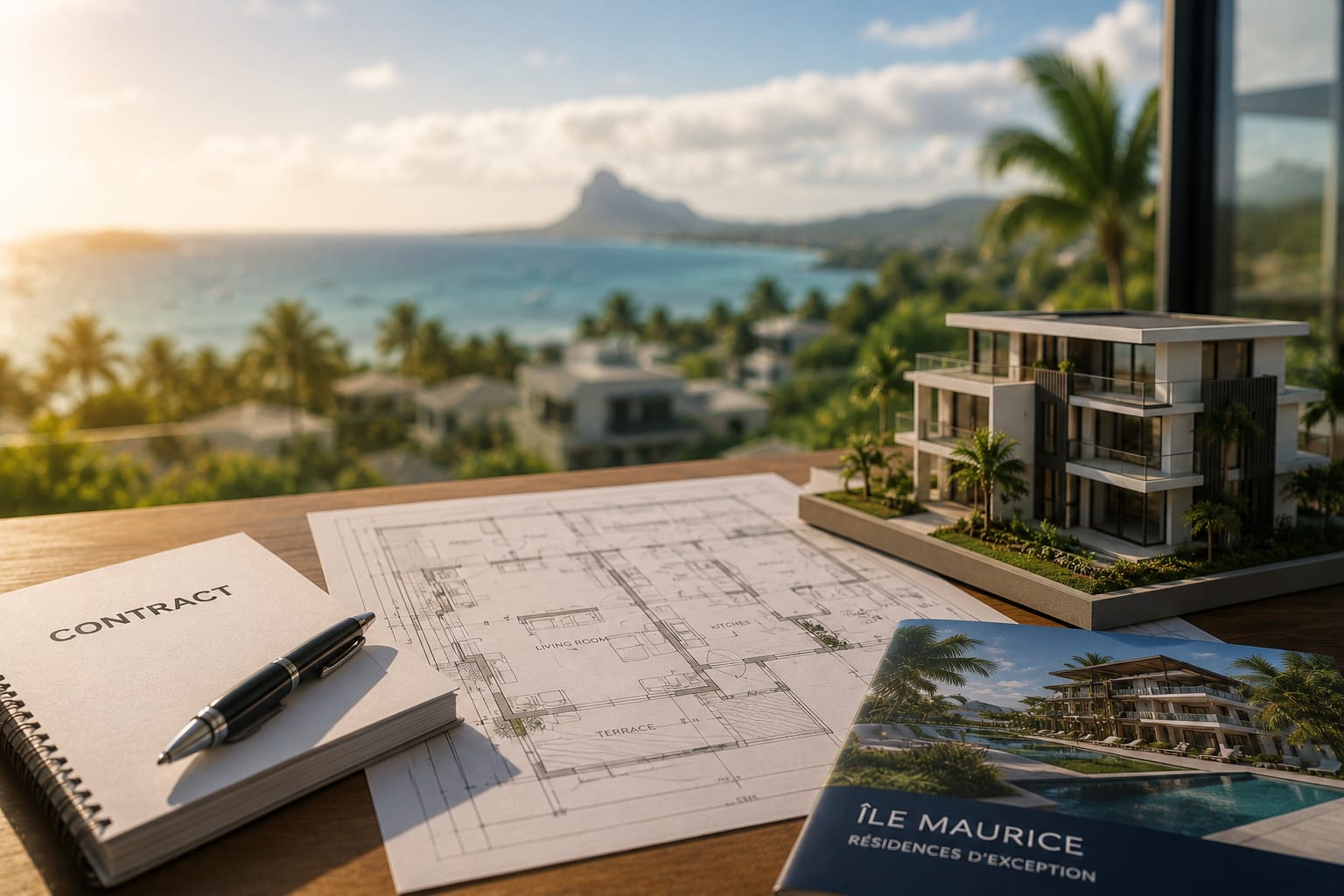


Yes, a foreigner can buy in Mauritius, in full freehold, with a title as solid as in Europe. Two main doors in: the approved schemes (villas and residences, residence permit included from USD 375,000) and apartments in R+2 residences, accessible from around €150,000. Here is the complete journey of a purchase, from the search to the handover of the keys.
Who can buy, and under which framework
Purchases by non-citizens are regulated through state-approved schemes, supervised by the Economic Development Board (EDB):
- The approved schemes (PDS, Smart City, and IRS/RES on resale): villas and apartments in serviced estates. From a USD 375,000 purchase, the permanent residence permit is included for the whole family.
- R+2 apartments: outside the estates, in buildings of at least two storeys, from Rs 6 million (around €120,000); in practice the market starts at around €150,000.
Each framework has its own logic and its own audience: our guide to the PDS, IRS, RES, Smart City and R+2 schemes helps you choose yours.
The 6 steps of your purchase
- Define the project and the full budget: the property price plus purchase costs, 7 to 10% of the price. If you are financing with a mortgage, get an agreement in principle before committing.
- Find the property: our team visits, films and checks every property in our catalogue. For new builds, our developments show unit price lists in real time.
- Reserve: signature of a reservation contract, deposit held in escrow by the notary. When buying off-plan, check the financial completion guarantee before signing anything.
- Obtain EDB approval for purchases in approved schemes: we prepare the file with you.
- Sign the deed before the notary: a single notary handles the transaction, verifies the titles and registers the deed. This is when registration duty is paid (5% of the price).
- Collect the keys, and if your purchase reaches USD 375,000 in an approved scheme, activate the family's residence permit.
Allow 3 to 6 months between the offer and the deed for a resale; off-plan, the timeline follows the construction with staged payments.
Why Mauritius keeps its investment promises
- Near-zero holding taxes: no property tax, no wealth tax, no capital gains tax, and rental income taxed on a scale capped at 20%: the details in our tax guide.
- A dynamic market: expat demand supports prices and rents, notably in the North and in the West.
- Genuine legal certainty: notaries, land registry, a hybrid French-British legal system, EDB supervision. Transactions are as tightly framed as in Europe.
- A lifestyle that speaks for itself: 300 days of sunshine, the lagoon as your screensaver, and English and French spoken everywhere.
To dig into each step
This guide lays the foundations; every key step has its detailed article:
- The real purchase costs: 7 to 10% of the price
- PDS, IRS, RES, Smart City, R+2: choosing the right scheme
- Buying off-plan: completion guarantee, payment schedule and traps
- Financing as a non-resident: up to 70% mortgage
- Taxation for expats in Mauritius
Frequently asked questions
Can a foreigner really buy in Mauritius?
Yes, in full freehold, within the state-approved frameworks (PDS, IRS, RES, Smart City) and in R+2 residence apartments from around €150,000. From a USD 375,000 purchase in an approved scheme, the permanent residence permit is included for the family.
How long does a purchase take?
Allow 3 to 6 months between the offer and the deed for a resale, depending on approvals and financing. Off-plan, the timeline follows the construction, with staged payments protected by the financial completion guarantee.
What costs should you expect?
Registration duty is 5% of the price, the rise to 10% of 1 July 2026 having been repealed on 31 July 2026. With the notary and ancillary costs, allow 7 to 8% for new builds (where agency fees are waived) and 9 to 10% for resale: the line-by-line breakdown is here.
Ready to move from the guide to a viewing? Our properties for sale, our new developments, or straight to a conversation with the team.